Top 5 Solana Market-Making & Token Management Tools in 2026
Market making, volume, anti-snipe, launch execution, wallet operations and post-launch management
The Solana launch stack has changed noticeably over the past two years. Token creation itself has been compressed into a handful of transactions and, on launchpads such as Pump.fun, much of the initial market setup is handled by the platform. The work that follows has moved in the opposite direction. Teams now routinely manage launch execution, sniper exposure, pools of operational wallets, treasury funding, automated buy and sell programs, volume campaigns and the day-to-day record of what those systems are doing onchain.
A small market can make each of those decisions consequential. When liquidity is thin, a few early transactions can establish the opening price and distribution; later, relatively modest orders can still move the market enough to change execution for every other participant. As a token gains holders and trading activity, wallet funding and inventory management also stop being one-off transactions and become recurring operations. This has produced a distinct category of software aimed at token issuers and market operators rather than traders looking only for a chart or a swap interface.
This guide looks at five products in that category: Tsunammi, Smithii, IDX AutoBot, RaydiumPump and SolBundler. Their scope differs considerably. Some concentrate on automated market activity, others on launch execution and bundling, while broader platforms connect those functions with wallet funding, token management and post-launch controls. The comparison below is organized around the jobs a token team actually has to perform, rather than around feature counts.
What token operations look like after launch
A quoted token price says very little about the amount of capital that can actually be traded around it. A market with shallow liquidity may display a multi-million-dollar valuation while a four- or five-figure order produces substantial price impact. The opening is even more sensitive: liquidity is at its thinnest, automated buyers are watching for new launches, and the first transactions can leave a lasting mark on both price and holder distribution. Once the opening passes, the operational problem changes again. Teams may be funding multiple wallets, maintaining automated campaigns, managing inventory and reviewing transactions across several systems. In practice, the software stack tends to break down into a small number of recurring functions:
The recurring jobs are straightforward. Launch execution moves a token from configuration into a live market. Anti-snipe and bundling deal with transaction ordering at the opening. Wallet operations create and fund the addresses used by the team. Market-making and volume tools automate repeated execution after a market exists, while market-response controls handle a changing price or inventory position. Finally, monitoring is the record of what actually happened: campaigns, funding, transfers, wallets and P&L.
The boundaries between these functions matter when comparing products. A bundler is primarily concerned with transaction ordering at launch. A volume bot takes over after a tradable market exists. Wallet-management tools solve a different operational problem again: getting capital to the addresses that will execute those strategies and keeping a record of the resulting activity. Some platforms package several of these functions together; others specialize in one stage. For a token team, the useful comparison is therefore how much of this operating chain a product covers and where another service or custom infrastructure is still required.
Anti-snipe and the opening market
The launch window is unusually sensitive to transaction ordering. Liquidity is still shallow and automated wallets can detect a new token or pool almost immediately, so the first block can account for a disproportionate share of early buying and supply concentration. The tools marketed as anti-snipe products generally address that narrow problem by coordinating the issuer's own launch transactions more tightly. SolBundler is built around Jito-based block-0 execution and multiple launch wallets; RaydiumPump combines token or pool creation with Jito bundles; Tsunammi includes anti-snipe in a wider workflow that continues into wallet funding and post-launch market operations. None of these mechanics substitutes for liquidity after the opening. They affect how a market starts; depth, inventory and continued execution determine what happens once normal trading takes over.
What “market making” means in this product category
The term is used loosely across Solana tooling. In some products it refers to repeated automated swaps designed to maintain a baseline of transactions and makers; in others it includes directional execution, inventory management or price-triggered orders. IDX AutoBot packages continuous activity into predefined execution engines. Smithii exposes campaign variables such as maker count, budget, volume and duration. Tsunammi separates buy-side, sell-side and conditional execution through Price Boost, Price Drop and Smart Buy/Sell, while RaydiumPump and SolBundler attach volume tooling to a launch-focused product.
Those differences are more useful than the shared “market maker” label. A team preparing a launch is primarily concerned with wallet preparation and the opening transactions. A live token may instead need a persistent execution program, a temporary campaign around a marketing event, or a way to reduce or accumulate inventory under defined conditions. The products below are best read as different implementations of those operating tasks.
The Top 5
1. Tsunammi — token operations from launch to post-launch execution
Best suited to: teams that want launch, wallet funding and market operations handled from the same Solana-focused system.
Tsunammi has the broadest remit of the five products reviewed here. The platform combines Create Token, launch and Anti-Snipe tooling, Wallet Pools, Connect CEX API, Distribute Funds from CEX, Price Boost, Price Drop, Smart Buy/Sell and separate market-making, wallet and token-activity histories. It also exposes parts of the platform through MCP. In practical terms, Tsunammi is designed around the sequence in which a token team works: prepare wallets and capital, launch, move into post-launch execution, then review the transactions and balances produced by those operations.
Preparing wallets and capital before launch
Multi-wallet execution creates a mundane but important problem before any market-making strategy begins: the wallets have to exist and they have to be funded. Tsunammi’s Wallet Pools page is the workspace for creating or importing the wallets used in an operation. Connect CEX API then links the funding source, and Distribute Funds from CEX provides a configuration screen for selecting the pool, setting a minimum and maximum deposit per wallet, and reviewing the total before execution. The interface matters because the operational task is not simply “send SOL”: it is allocating a defined amount of working capital across a group of execution wallets without reconstructing the distribution manually for every campaign.
Buy-side, sell-side and conditional execution
Tsunammi does not package every post-launch action into a generic volume campaign. Price Boost is built around buy-side execution, Price Drop around controlled sells, while Smart Buy/Sell lets the operator define conditions for automated transactions. That distinction matters for teams managing inventory as well as activity. A market that has absorbed a large sell-off presents a different operational problem from one in which the treasury wants to reduce exposure after a rally, and the platform exposes separate controls for those cases.


A record of market and wallet activity
With several wallets in use, a block explorer quickly becomes an awkward way to reconstruct an operating session. Tsunammi separates MM History, Wallets Ops History and Token Activity History into dedicated views. That gives the operator a chronological record of market actions, transfers and token events and makes it easier to compare an executed campaign with what happened in the market afterward.
MCP as an additional control layer
Tsunammi also exposes parts of the platform through MCP, with support advertised for Claude, Cursor and other compatible clients. Credentials are account-specific and protected behind sign-in. The integration is relevant where the work is repetitive—checking balances, reading project state, monitoring campaigns or invoking pre-defined operations—because it gives teams an alternative to building their own internal dashboard or scripts around the same routine tasks.
Tsunammi’s role: create → launch / anti-snipe → create / fund operational wallets → execute market actions → monitor histories → automate workflows. It covers the largest portion of the token-operator lifecycle in one interface.
2. Smithii — a modular catalogue of launch and market tools
Best suited to: teams that prefer separate no-code utilities for specific token operations.
Smithii takes a more modular approach. Its Solana catalogue includes token creation, bundlers, a Volume Bot / Market Maker, maker-generation tools, liquidity-pool utilities, multisender and token-administration functions. Rather than centering the workflow on one token workspace, Smithii presents these capabilities as individual tools. A project can therefore use the platform for a bundler at launch, return later for a volume campaign, and use another utility for liquidity or token administrationSmithii token toolkit
Configuring volume and makers as a campaign
The Smithii Volume Bot is organized around a set of campaign parameters: makers, target volume, budget and duration. The service then executes swaps across multiple wallets according to that configuration. It is a direct fit for teams approaching the task numerically, for example maintaining a level of activity for a fixed period or targeting a defined number of makers.
Use case: combine launch tools with administrative utilities
Smithii also sits across multiple token jobs outside pure MM. Its catalog includes bundlers, token creator, multisender, snapshots, authority-management tools and liquidity-pool actions. A founder can therefore use the same vendor for launch mechanics, token administration and market-activity campaigns, even though those tools remain more modular than Tsunammi's connected operating workflow.
Smithii's role: creation → bundling → volume/maker campaigns → basic liquidity operations → token utilities. The defining characteristic is breadth of individual no-code tools.
3. IDX AutoBot — automated execution for an existing market
Best suited to: projects that already have a tradable token and want continuous automated activity rather than a broader launch stack.
IDX AutoBot is narrower than Tsunammi or Smithii. Its core product is an onchain market-maker / volume bot: the operator enters the token mint, connects and funds a wallet, chooses an execution engine and monitors the bot from a dashboard. IDX supports routes across Solana venues including Pump.fun, Raydium, Orca and Meteora, while its documentation notes that the token must already have liquidity. It is therefore principally a post-launch tool, designed for markets that already exist and need an automated execution program.
The public interface highlights several engine profiles, including V4, V6 and V8, with different levels of trading intensity. IDX documentation also allows multiple engines to run on the same token. The profiles vary in areas such as transaction frequency, wallet count, expected volume and operating cost, giving the operator a preset alternative to designing the timing of every buy and sell from scratch.
IDX AutoBot’s public Market Maker visual. The live product page documents the V4/V6/V8 engine profiles, gas level, 24-hour volume, makers-per-day and start, pause and recharge controls.
Use case: maintain a baseline after launch
This is the most natural IDX use case. The token has already launched and has a supported liquidity route. The team can attach a lower-intensity engine to maintain a persistent execution baseline rather than manually generating trades. During a marketing event or stronger growth push, another engine can be layered on top. IDX's current documentation explicitly supports simultaneous engines and gives operators live controls to pause, resume, recharge or stop them.
Use case: manage several market-making bots from one dashboard
IDX emphasizes the dashboard as an operator surface. Teams can monitor active bots, generated volume, wallet-pool balance and engine status, then pause or recharge individual bots. This is a narrower product than Tsunammi because it does not attempt to own the entire launch-to-treasury workflow, but that specialization can be useful when the only missing component in the stack is continuous automated market activity.
IDX AutoBot's role: existing tradable token → select execution engine → fund dedicated wallet pool → automated swaps → live monitoring / pause / recharge. Its specialty is persistent MM/volume automation.
4. RaydiumPump — launch, Jito bundles and volume operations in one developer dashboard
Best fit: Solana developers who want a combined launch-and-volume workflow for Pump.fun/PumpSwap and Raydium routes.
Despite the name, RaydiumPump is not the Raydium DEX itself. It is a separate token-operator service built around launch and post-launch automation. Its current site offers two main starting points: launch on Pump.fun using a bonding-curve flow with Jito-coordinated buys, or launch on Raydium by minting the SPL token and creating a CPMM pool. Existing tokens can instead be pasted into the interface and connected directly to the volume bot. The same site says the bot can auto-detect AMM V4, CLMM, CPMM and PumpSwap routes.
This creates a fairly complete launch lifecycle: create the token, configure initial buys, deploy the market and then transition into repeated volume execution. The service also exposes authority controls and wallet recovery/sweep functionality. Compared with IDX, RaydiumPump starts earlier in the lifecycle; compared with Tsunammi, its workflow is more heavily centered on launch + volume automation rather than broader treasury and market-response tooling.
Use case: Pump.fun launch followed by automated post-graduation activity
RaydiumPump describes a flow where the team creates the token, executes the launch through Jito, runs activity across 20+ wallets and then automatically detects graduation from the bonding curve, switching the bot to PumpSwap. The operational value is continuity. The team does not have to stop its campaign simply because the token moved from the launch curve into the post-graduation market.
Use case: launch directly into a Raydium pool
The second workflow mints the SPL token, configures the CPMM pool and initial liquidity, optionally coordinates launch-wallet buys with Jito, and then uses the same volume bot after the pool exists. For a team that wants a direct token → pool → market-activity route in one interface, this is the product's clearest differentiator.
Use case: authority and holder controls
RaydiumPump also surfaces mint/freeze authority management and holder-monitoring actions in the same dashboard. These are more token-administration oriented than classic market making, but they matter operationally because the team can manage the launch configuration and the trading campaign without switching to another admin utility immediately afterward.
RaydiumPump's role: create token → Jito-coordinated launch → create/identify trading route → automated multi-wallet volume → post-graduation continuation → authority/recovery tools. Its center of gravity is launch + automated market activity.
5. SolBundler — block-0 launch execution with wallet coordination and post-launch tools
Best fit: Pump.fun teams for whom the primary requirement is launch execution, Jito bundling and coordinated wallet management, with lightweight post-launch tooling included.
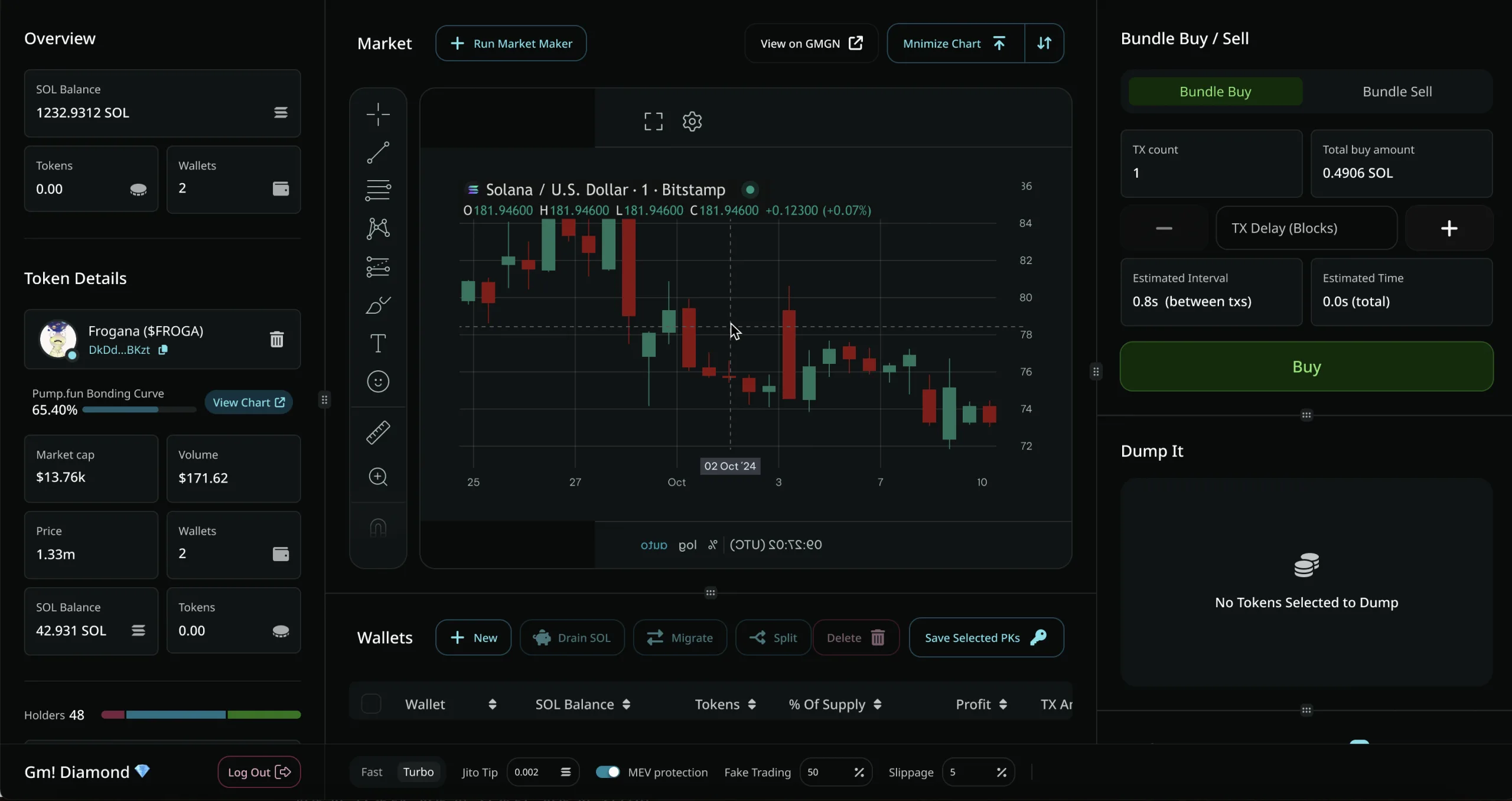
SolBundler is built specifically around the mechanics of the opening block. Its core product coordinates token creation and wallet buys through Jito so the launch transactions execute together. The current dashboard supports up to 20 managed wallets, individual wallet-level buy/sell/withdraw controls, balance and token tracking, and P&L monitoring. Unlike a pure bundler script, the product also adds post-launch tools including Smart Sell and Volume Maker, which is why it belongs in this comparison rather than in a list of one-time deployment utilities.
Use case: coordinate the launch block across multiple wallets
The SolBundler launch workflow lets the operator configure token details, select bundle wallets, assign buy amounts and submit the coordinated launch through Jito. The product then tracks what landed and exposes the wallet balances and holdings in the dashboard. This removes much of the manual RPC, transaction-building and wallet coordination that a developer would otherwise need to implement in a script.
Use case: manage distributed inventory after launch
After the initial execution, SolBundler's Smart Sell is designed to distribute sell execution across bundle wallets rather than requiring the operator to open each wallet individually. The same dashboard includes withdrawal and wallet consolidation operations. In practice, this turns the bundle-wallet set into a manageable operating group rather than twenty unrelated addresses.
Use case: continue with a lightweight volume layer
SolBundler also includes Volume Maker, giving a team a path from launch execution into post-launch trading activity without immediately connecting a separate service. Its MM functionality is less broad than a dedicated automation platform such as IDX or an operational stack such as Tsunammi, but it fits naturally for projects whose primary stack revolves around the Pump.fun launch itself.
SolBundler's role: configure token + wallets → Jito/block-0 launch → monitor wallet positions → Smart Sell / withdraw → Volume Maker. Its defining specialization is coordinated launch execution.
How the products differ in practice
Tsunammi covers the widest stretch of the operating chain: launch and anti-snipe, wallet pools, CEX funding, explicit buy-side and sell-side controls, histories and MCP. Smithii has the broadest modular catalogue, with separate tools for creation, bundling, volume and token administration. IDX AutoBot is the most focused on continuous market-maker and volume-engine operation. RaydiumPump links launch mechanics and volume automation in one developer flow. SolBundler is built around the launch block and coordinated wallets, with enough post-launch tooling to manage the inventory that launch creates.
The comparison makes the market structure clearer. Tsunammi is the broadest operating layer and is strongest when the team wants to manage the token across several stages rather than buy one isolated utility. Smithii offers the broadest modular catalog. IDX AutoBot goes deepest into continuous market-maker / volume-engine operation. RaydiumPump combines token launch and volume automation into a single developer workflow. SolBundler specializes in the launch block and multi-wallet coordination, then adds enough post-launch tooling to keep those wallets operational afterward.
A practical stack by stage
Before launch
The team's job is configuration and preparation. This is where Tsunammi Wallet Pools + CEX funding/distribution, Smithii's creator/bundler utilities, RaydiumPump's creation flow and SolBundler's wallet/bundle setup are relevant. Capital should already be where it needs to be before the launch transaction becomes time-sensitive.
Launch window
The focus shifts to execution. Tsunammi’s anti-snipe launch flow, RaydiumPump's Jito-coordinated launch and SolBundler's block-0 specialization all address the opening from different angles. Smithii offers bundler utilities for teams that prefer its modular toolkit.
First days after launch
The operational question changes from “how do we open?” to “how do we keep the market functioning and respond to it?” Tsunammi’s Price Boost, Price Drop and Smart Buy/Sell are designed for explicit market actions. IDX AutoBot becomes useful when the token already trades and the team wants continuous automated activity. Smithii and RaydiumPump offer volume-bot workflows, while SolBundler's Volume Maker provides a lightweight continuation for teams already using its launch stack.
Ongoing operations
Once the market is established, monitoring and repeatability matter more than launch mechanics. Tsunammi’s separate operation histories and MCP layer are designed for a persistent operator workflow. IDX's dashboard is useful for teams running several continuous engines. SolBundler's P&L and wallet controls remain useful where launch-wallet inventory is still being managed. At this stage, the best tool is less about “which one can create transactions?” and more about which interface matches how the team actually runs its treasury, wallets and market operations every day.
Which tool should a token team choose?
There is no universal answer because these products expose different levels of the stack. A team looking only for a configurable volume campaign may prefer Smithii or IDX AutoBot. A Pump.fun developer whose main risk is the opening block may care most about SolBundler. A team that wants to create the token, coordinate launch execution and immediately continue into a multi-wallet volume workflow may find RaydiumPump a natural fit.
For a team expecting to manage the token as an ongoing market rather than as a one-time launch, Tsunammi has the widest operational surface in this group. Wallet Pools and CEX funding solve the capital-distribution problem before execution begins; anti-snipe and launch tooling cover the opening; Price Boost, Price Drop and Smart Buy/Sell expose separate post-launch market actions; histories keep the execution trail readable; and MCP adds a programmable automation layer on top. That combination reflects the broader direction of crypto market infrastructure: professional trading and treasury workflows are increasingly being packaged into interfaces that small teams and independent founders can actually operate.
Bottom line: choose the tool based on the operating problem. Launch protection, continuous market activity, wallet funding and active market management are related jobs, but they are not the same job. The strongest token stack is the one that connects the jobs the team actually has to perform after the launch button is clicked.